

The Simple View of Writing (Berninger & Amtmann, 2003), a theoretical model of the components of written expression, provides a framework for understanding the relationship between transcription (i.e., handwriting, spelling) and writing length and quality.
When students can quickly and efficiently transcribe their ideas, more cognitive resources are available to devote to higher-order writing skills, such as idea generation, organization, and revision. That is, as students’ handwriting fluency and spelling skills increase, increases in the length and quality of their writing are also observed (Datchuk & Kubina, 2013; McMaster et al., 2018).
Because of the important contributions of students’ transcription skills to their overall writing ability, it is important to monitor students’ development of these skills. Ongoing assessment of transcription skills, including handwriting, provides an opportunity for teachers to monitor students’ fluency and identify letters requiring additional instruction.
Handwriting Fluency Assessments
The IRRC’s Literacy LIFTER handwriting curriculum includes two downloadable handwriting fluency assessments: the Alphabet Task (Berninger & Rutberg,1992) and the Copy Task (Graham et al., 1997). On both tasks, handwriting fluency scores are reported as the number of correct letters formed per minute (CLFPM). The total score reflects both the legibility of letters and the rate at which the student produces them. You can learn more about handwriting fluency in the LIFTER eLearning module, Lesson 6: “Assessing Handwriting.”
Assessment | Description |
|---|---|
| Alphabet Task | The Alphabet Task is a timed measure of students’ ability to write letters of the alphabet in order without a model as many times as they can in 60 seconds. |
| Copy Task | The Copy Task is a timed measure of students’ ability to copy a given sentence (e.g., “The quick brown fox jumps over the lazy dog.”) as many times as they can in 90 seconds. |
These tasks are researcher-created handwriting fluency measures that have been commonly used in writing studies (Kent & Wanzek, 2016). Notably, there is some variability in specific scoring procedures that have been used in prior studies. Therefore, the IRRC’s handwriting fluency assessment administration guides provide suggested scoring guidelines. These suggestions are intended to support consistent scoring across scorers, student writing samples, and time points to inform instruction. We offer two recommendations to support this endeavor.
1. Consider the identifiability of letters out of context.
2. Apply scoring guidelines consistently.
1. To Determine if Letters Are Legible, Consider the Identifiability of Letters Out of Context.
When scoring, consider whether each letter can be easily identified, independent of context. We consider letters meeting this criterion as legible letters. This definition is consistent with the Simple View of Writing (Berninger & Amtmann, 2003) and reduces some subjectivity around penmanship.
To illustrate how teachers can apply this definition of legible letters, we provide examples and nonexamples below. You will see that some letters are not perfectly spaced within the provided lines. For instance, in Example 1A, the enclosed loop forming the letter “o” closes above the midline. Similarly, in Examples 4A and 4B, the letter “g” crosses the midline. Because these letters are identifiable, we recommend scoring them as correct.
Examples of Legible and Illegible Letters
| Letter | Legible Example 1 | Legible Example 2 | Illegible Letter and Explanation |
|---|---|---|---|
| o |
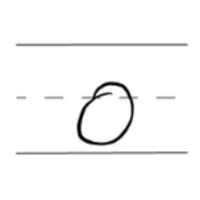
|
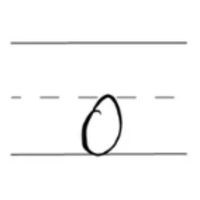
|

Rationale: The letter appears to be an “a” in isolation. |
| p |
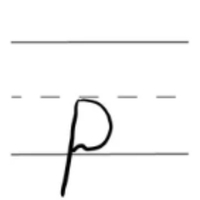
|
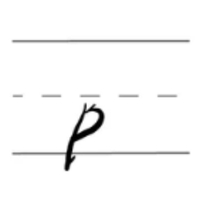
|

Rationale: The loop is on the left side of the line instead of the right. |
| y |

|

|

Rationale: The letter is not identifiable in isolation. |
| g |
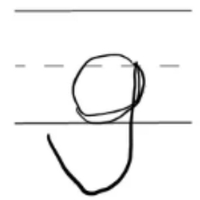
|
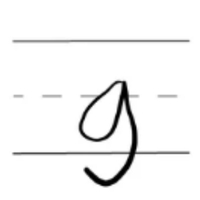
|
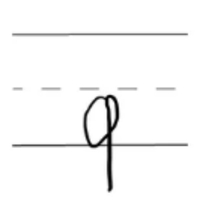
Rationale: The hook is not fully formed and could be identified as “q” rather than “g.” |
2. Apply Scoring Guidelines Consistently.
Applying the scoring guidelines with consistency reduces the risk of introducing variability in students’ scores that don’t reflect true changes in student performance. In the “Scoring Guidelines” section of the Alphabet Task and the Copy Task administration guides, we provide detailed descriptions of each error type along with examples.
Alphabet Task
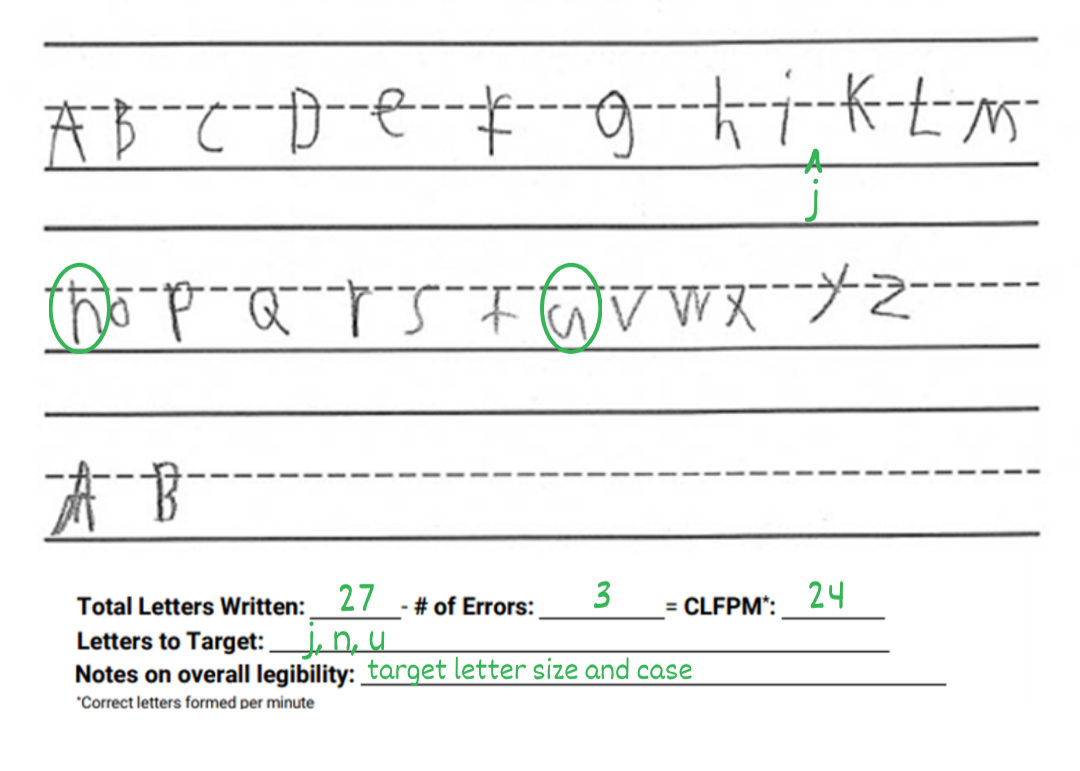
A student’s total score for the Alphabet Task equals the total number of letters written minus any errors. Potential errors include an omitted or inserted letter in the alphabet sequence (e.g., abfcd), a break in the alphabet sequence (e.g., abcdeflmnop), transposed letters (e.g., abcdegf), or an illegible letter (see Table 1 for examples). One point is deducted from the total score for each error. You can find more specific descriptions of error types and additional examples in the “Scoring Guidelines” section of the Alphabet Task administration guide.
Although grade-level norms are not currently available, the Alphabet Task can be used to monitor students’ letter recall, letter formation, and handwriting rate over time. Additionally, teachers can record observations of letter size, spacing, and case and can note letters requiring additional instruction. However, these variations should not be scored as errors for the Alphabet Task.
Below is an example of a scored Alphabet Task to illustrate the scoring guidelines.
Example of Scored Alphabet Task
Type of Error | Errors Identified |
|---|---|
Omitted letter or break in alphabet sequence (^) | j |
| Inserted letter (/) | N/A |
| Illegible letter (o) | n, u |
| Transposed letters (← →) | N/A |
| Mixed error types | N/A |
Note: We identified three errors in this scored Alphabet Task writing sample: one omitted letter and two illegible letters. The letters “n” and “u” are scored as illegible because they could be misidentified as “h” or “a” out of the context of the alphabet sequence.
Copy Task
Similar to the Alphabet Task, the total score for the Copy Task equals the total number of letters written minus any errors, with an adjustment for its longer administration time. Most error types are shared by both tasks (i.e., inserted, omitted, illegible, or transposed letters), but the Copy Task includes a few unique scoring procedures.
First, the model sentence is intended to be copied in sentence case, as written. Thus, we recommend considering each letter written in the incorrect case as an error (e.g., the Quick browN fox...). We recommend using the size and spacing of surrounding letters as a reference point when distinguishing between upper- and lowercase letter forms that are identical apart from their size (e.g., O/o or X/x).
Second, omitted words or a break in the sequence of words in the model sentence require consideration. We suggest that scorers deduct one point if a student omits one word (e.g., “The quick [brown] fox”) or several consecutive words in the provided sentence (e.g., “The quick [brown fox] jumps over...”). This approach yields scores that more accurately reflect the student’s writing rate.
Additional details about scoring recommendations along with general reference points for the average number of correct letters formed per minute on the Copy Task for Grades 1–9 students (Graham et al., 1998) are provided in the administration guide.
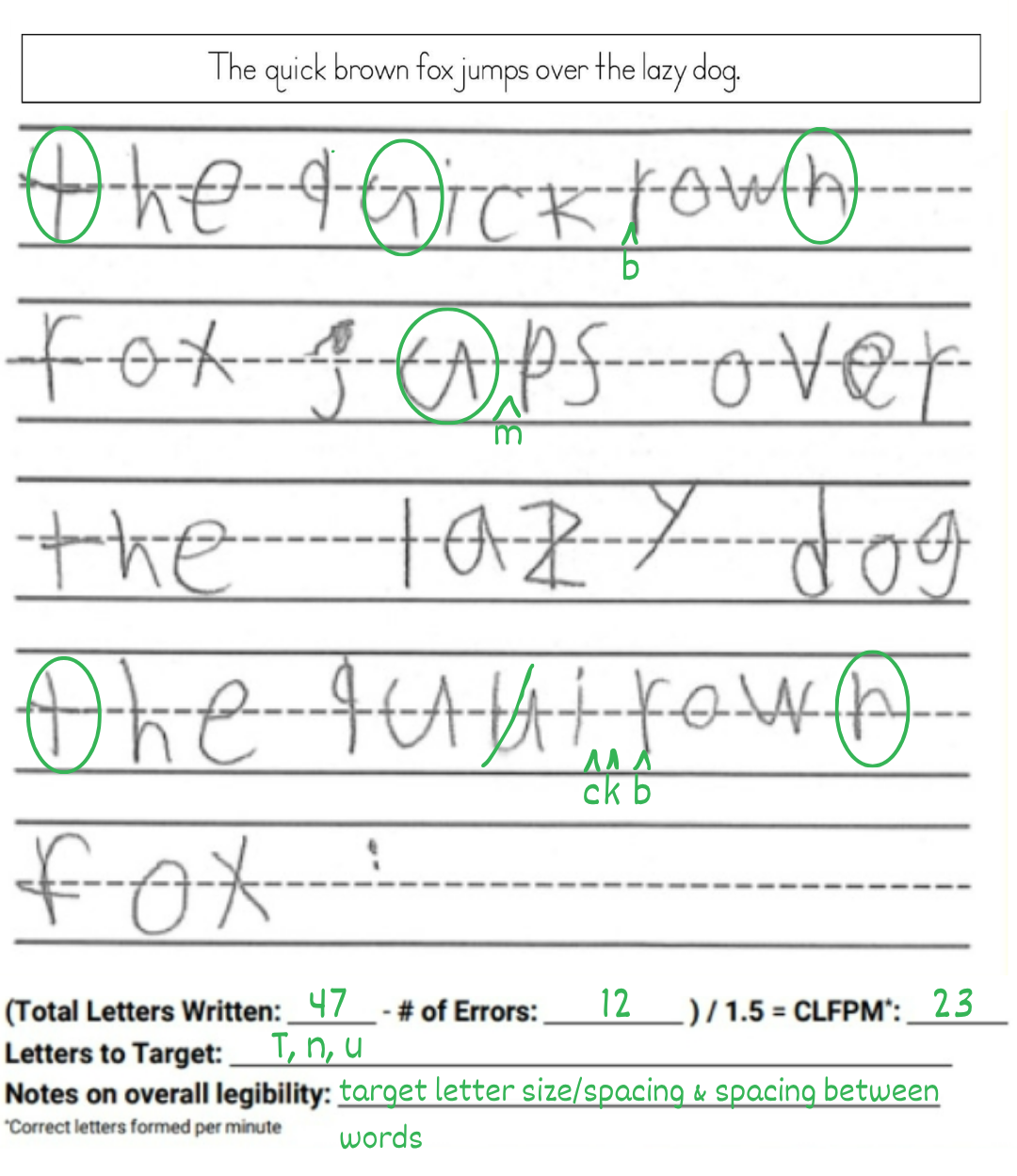
Below is a scored Copy Task that illustrates these scoring guidelines.
Example of Scored Copy Task
Type of Error | Errors Identified |
|---|---|
Omitted letter, word or break in sequence (^) | b, m, c, k, b |
| Inserted letter (/) | u |
| Illegible letter or incorrect letter case (o) | T (case), u, n, u, T (case), n |
| Transposed letters (← →) | N/A |
Note: We identified twelve errors in this scored Copy Task writing sample: five omitted letters, one inserted letter, two letters written in the incorrect letter case, and four illegible letters. The letters “n” and “u” are scored as illegible because they could be misidentified as “h,” “r,” or “a” out of the context of the word or sentence.
When scoring handwriting fluency assessments, it is important to remember that children are still developing fine motor skills and that producing certain letter strokes (e.g., curved strokes) is especially challenging for emerging writers (Fitjar et al., 2024). Therefore, in addition to calculating an overall rate score, we recommend further review of student writing samples to look for variations in letter formation that may need to be addressed. We have provided additional space on the assessment scoring sheet for you to: (a) record these observations of variation in letter size, pressure, and spacing without scoring these variations as errors and (b) identify letters to target in future instruction. Combining these approaches yields a more complete picture of students’ progress towards efficient and legible letter formation over time.
References
Berninger, V. W., & Amtmann, D. (2003). Preventing written expression disabilities through early and continuing assessment and intervention for handwriting and/or spelling problems: Research into practice. In H. L. Swanson, K. R. Harris, S. Graham, H. L. Swanson, K. R. Harris, & S. Graham (Eds.), Handbook of learning disabilities (pp. 345–363). Guilford Press.
Berninger, V. W., & Rutberg, J. (1992). Relationship of finger function to beginning writing: Application to diagnosis of writing disabilities. Developmental Medicine & Child Neurology, 34(3), 198–215.
Datchuk, S. M., & Kubina, R. M. (2013). A review of teaching sentence-level writing skills to students with writing difficulties and learning disabilities. Remedial and Special Education, 34(3), 180–192. https://doi.org/10.1177/0741932512448254
Fitjar, C. L., Rønneberg, V., & Torrance, M. (2024). Assessing handwriting: A method for detailed analysis of letter-formation accuracy and fluency. Reading and Writing, 37(2), 291–327. https://doi.org/10.1007/s11145-022-10308-z
Graham, S., Berninger, V. W., Abbott, R. D., Abbott, S. P., & Whitaker, D. (1997). Role of mechanics in composing of elementary school students: A new methodological approach. Journal of Educational Psychology, 89(1), 170. https://doi.org/10.1037/0022-0663.89.1.170
Kent, S. C., & Wanzek, J. (2016). The relationship between component skills and writing quality and production across developmental levels: A meta-analysis of the last 25 years. Review of Educational Research, 86(2), 570–601. https://doi.org/10.3102/0034654315619491
McMaster, K. L., Kunkel, A., Shin, J., Jung, P. G., & Lembke, E. (2018). Early writing intervention: A best evidence synthesis. Journal of Learning Disabilities, 51(4), 363–380.